
Nhiigiliirr Gundhilgaa-gu

Jun 28
7 min read
Necklace for a city
This story was presented at the 'Time to Listen' Conference at the Akadamie der Kunst, Berlin on 27th June, 2026. I attended as a Post Doctoral Research Associate in the Resonant Earth: Music, ecology and climate justice ARC project led by ARC Laureate Professorial Fellow Liza Lim at the Sydney Conservatorium of Music, The University of Sydney
A friend said to me not so long ago, “Nardi, you’re always on some crazy side quest.”
She knows me really well. She knows the things I am most passionate about, and she knows the projects I plan and create for myself to do. What I reckon she was noticing and commenting on, is how frequently I seem to be pulled away from the things I devise - to follow ideas and opportunities that arise around me. And she’s right. I’m lucky that way. Outside of the work I have planned for myself, I am often invited to be part of projects that in some way or another have made themselves available to me.
My acceptance of these “side quests” could of course be avoidance on my part. It could also be short attention span. It perhaps could be a necessary prerequisite of life as a creative. It may be a manifestation of fear, or ego or a longing for acceptance. And each of these may carry some truth. But in any case, the work I am officially here to do is share ways I harness my cultural obligations to create work that is an active and equal participant in Yuwaalaraay ecology, culture, and relationship.
However, a couple of days ago I took a walk in the neighbourhood where we’re staying. It was a big deal for me because I’m petrified of Berlin. It is a very different place for me to be in. Mostly because I spend the majority of my time in an Aboriginal world. My family is Aboriginal, my friends are aboriginal, I work primarily with Aboriginal people and within Aboriginal communities. I think and laugh and rage and make within the Aboriginal worlds I belong to. And…Berlin? It’s a very long way from any of those things. Here, I am furthest from myself than I have ever been. The roads are different, the footpaths terrifying, the trains are confusing, the money and language and landscape are all indecipherable to me. So, going for a walk, by myself was very brave.
I headed towards a park where I knew the sun and the sounds and smells and spirit of what we call ‘baayangali’- the natural order of things- would help me formulate a plan about how to share the things I care about. But as I walked and thought about the things I know, I also questioned whether that knowledge is relevant here, essential to this environment. Sure, it would work in the context of this conference, but was it useful to the land? The birds, the squirrels, the river and the sun? What about the layers of time, the stories and spirit of this place? Could my knowledge serve them? Yuwaalaraay concerns are insignificant here and being Aboriginal in Berlin, is rightfully, unimportant. So rather than regurgitation what I knew, my meditation shifted into an interrogation. How might I be relational and respectful to the layers already existent here? How can I be an active participant in another country’s story without misinterpreting or dominating or centering my own needs and knowledge? How am I useful to this landscape? How can I enact positive relation in ways that uphold my obligations to my own ecosystem, while serving the resonances of this place? Can you even do that? Maybe a park would help me to know.
After looking the wrong way, twice, I crossed the street. A gold ribbon had fallen on the footpath. It had landed at the junction of the pavement and bike lane. I imagined it falling from the head of a child, cascading to the ground as she giggled, tucked safely into the capsule of her parents’ bike. I hopped over the ribbon and kept on but, in another few steps, a different golden shimmer caught my eye. This was a brass stumbling stone. It marked the home of David Jelski, a Polish man who moved to Berlin in 1907 then married a woman named Klara. After working as administrator and office manager of a Jewish Community Center, in his retirement, at the age of 70 he was taken to Theresienstadt and died there in 1943. His glinting, golden memory moved me to pick up the ribbon. Holding it I looked up at the building. He and Klara had lived on the third floor. My spirit filled with winanga-li (thinking, knowing, remembering, listening, respecting, loving) – in my hand and at my feet were both joyous beginnings and horrifying endings - coexisting and speaking through time, in place.
Entering the park I noticed a tree- expansive and broad, its leaves rich copper velvet. I google translated the sign at its base:
“Natural Monument”
Copper Beech
Approx. 150 years old
Crown height 20 metres.
This copper beech is protected. It is native to Europe and Asia Minor and due to its blood red coloration is a valuable specimen tree for parks and green spaces.
What a beauty! What a survivor! I walked over and placed my hand on her trunk said hello. And thank you. And passed on the respects of my family. And of the trees that I’m connected to and that know me. The copper beech bought Uncle Max into my mind. I filled with memories of his cheekiness and wisdom, the beauty of his saltwater country and the generosities it had extended to me. I remembered his wiry, full, white beard. I hoped somehow, though my touch, that maybe he could sense the wisdom and sacredness of that marvellous beech. I entered Carl von Ossietzky Park and ate a salami sandwich, cooled by the breeze and the shade of the maples and oaks.
Connected and happy I made my way to Tiergarten. There I came across a small pond. At its edge were what I recognised as river reeds. We have the same species of plant in Yuwaalaraay, and I couldn’t believe my eyes when I saw it. Noticing a few stalks had detached and lay on the bank at the edge of the water, I went to them. In my mind’s eye as I approached was my sister Lucy. She is an artist and designer and a magnificent maker. She is a gentle and thoughtful person who immerses herself in an embodied practice. We are opposites in many ways. I make noise while she makes silent, striking beauty. Through her research she uncovered traditional Yuwaalaraay processes for harvesting and making reed necklaces and has made several beautiful pieces since. She now passes on this knowledge to young Yuwaalaraay women and girls, sharing so they too can reconnect to knowledge and practice. My sister was close as I came to the water. I asked the reeds if they would mind me taking the fallen stalks. A wind rose through the stems. They rustled and bent towards me, so I gathered the dead fronds and bound them with the gold ribbon. I am often doing this- scavenging. I do it because I believe there is music in everything, always- even in that which we assume to be dead or decaying. Finding the song in a dying reed is a way for me to honour and respect the living plants in their place, clustered and drinking from the waters of Tiergarten. I was delighted to see in a Berlin park an ecology I knew existent in my own homelands. I was also happy that I knew ways to fashion respect for this country with that material.
Carrying the bundle in the falling sun I planned for the next day, now much more confident in navigating this city. Tomorrow I would go to the Neues Museum before attending Spreeklänge. The next blazing morning I caught the S-Bahn and made my way to the museum. At the apex of Friedrichsbrücke I came across another ribbon on the ground, this one soft pink and short. I picked it up without hesitation. Rolling it into a tight tube I continued over the bridge. Granite pillars, pock marked and impact scarred stared down. The ribbon’s cylindrical shape transformed into bullet in my fingertips. Again, the resonance and history of the city arrested me. I put the ribbon in my bag and continued on.
I had a wonderful day despite getting incredibly lost more than once. Eventually I got myself to the beginning of the walk and spent time with the Spree, listening and thinking and hearing and being. It was hot and I was thankful for water. It was bright and I was grateful for shade. I walked past my colleagues, their notes flowing with the river before dissolving into the cityscape. And at the last station, I had almost worked out what had been happening around and to me these last few days. Carlos, Tati and their fellow musician’s gentle engagement of human breath with the breath of the land was the beginning of my realisation. The tinkling of the ceramic chimes from Tati’s sound mask confirmed it- a message to Yuwaalaraay via Boliva delivered in Berlin.
The side quests aren’t the distraction. They are the correction. They are the calling. They are the service that ecosystem, ancestor, country and culture require. Side quests are the work. They are the agenda decided then setup then gifted to you.
I am wearing this current side quest. It hangs from me as a realisation of how to respect and listen and acknowledge that to which I don’t belong. It is an expression of the love I carry for my culture and country that I extend into faraway lands. It is a way I exercise respectful, useful, strong ways to be in the place I now sit within.
This work is a combination of stories, and confluence of knowledges that flow through and over and between us. It is ribbon and stumbling stone and river and bullet hole, it is tree and S-Bahn and the top of a bridge in stinking hot heat. It is coffee and conference room and reviving tradition, it is babies, and old men and master teachers, and the lives they have led or are about to commence. It is a collection of lost and dying things. It is the tours and talks and walks and walls that began writing this presentation while I wondered what to say. It is a throw away comment by a best friend. And a much more interesting plan than the one that I had. The side quest is country speaking. Thank you Berlin, thank you river Spree and thanks to all of you, for helping me hear.
Spree River, Berlin 
Copper Beech Common Reed, Tiergarten 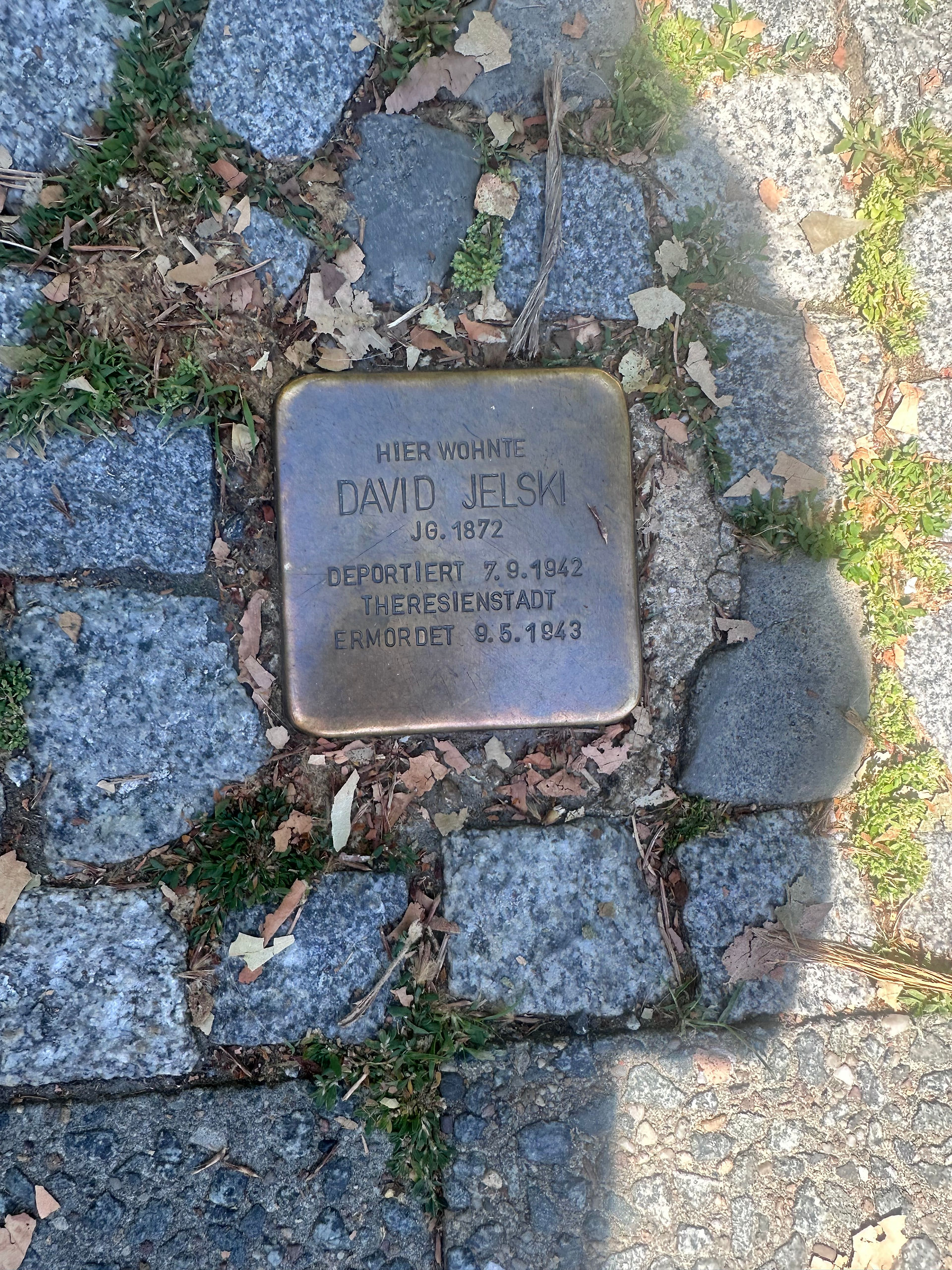
Stolpersteine of David Jelski Ribbon and Reeds Nhigilliirr Gundhilgaa-gu

What a gift to read your writing! What a gift to see how you interpret your surroundings! What a gift to the world you are ❤️
Thank you for gifting us this mind boggling and heart expanding story of time and place. Lovely to witness this journey. Steph x
What a beautiful reflection. I absolutely loved reading this and I could see you wandering, I could see the ribbons and reeds and that blood red tree …. What a wonderful story to share. Thanks
Thank you for this Nardi